
‘In What Capacity?’ ADC Spokesman Fires at Nwosu Over INEC Letter
ABUJA
Nigeria’s opposition landscape was further rattled on Tuesday as the leadership crisis within the African Democratic Congress (ADC) took a sharper political turn, with the party’s Acting National Publicity Secretary, Bashiru Abdul Mohammed (BAM) launching a blistering attack on its founding chairman, Ralph Okey Nwosu.
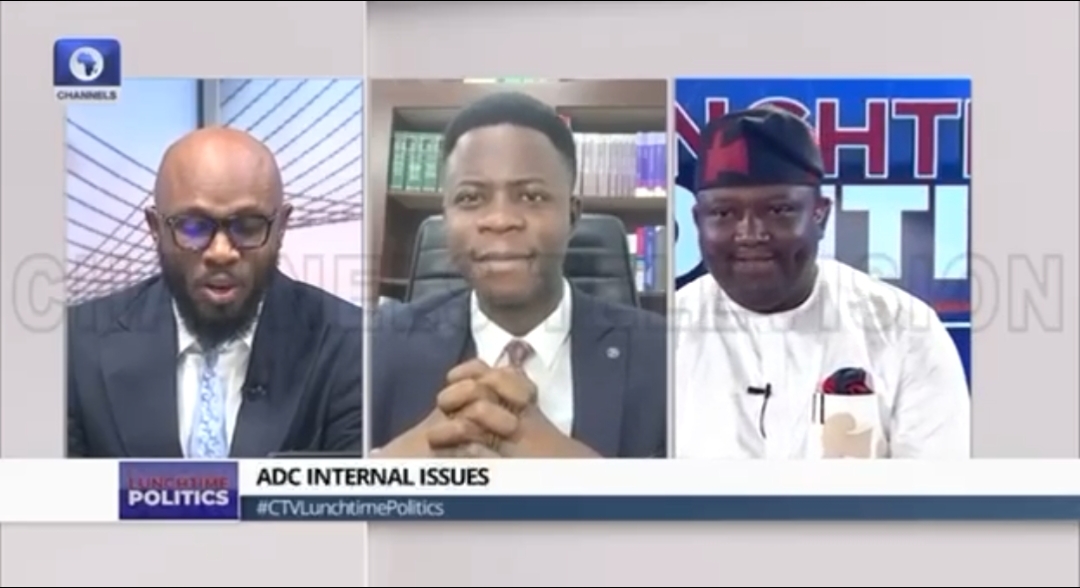
Speaking on Lunchtime Politics, a flagship political programme on Channels Television, Tuesday 7th April 2026, the party spokesman cast serious doubt on the legality, intent, and political implications of Nwosu’s actions following his alleged resignation on July 2, 2025.
In a strongly worded intervention, he challenged what he described as an “unconstitutional overreach,” questioning the propriety of Nwosu’s letter to the Independent National Electoral Commission (INEC) dated August 6, 2025—nearly a month after he reportedly vacated office.
“Can a man who has resigned as National Chairman still wield the powers of that office? In what capacity did he purport to act?” he queried, framing the development as a direct test of internal democracy and party discipline.
Escalating his criticism, the spokesman described the move as politically suspicious, asking how Nwosu could communicate officially with INEC 27 days after stepping down, and whether due process was ever followed in his exit.
He further raised fundamental governance concerns within the party, questioning whether any valid National Executive Committee (NEC) meeting was convened prior to the resignation, as required by the party’s constitution.
“Was there a properly constituted NEC where this resignation was presented and adopted? Or are we witnessing a unilateral decision dressed as due process?” he asked.
Taking the battle lines further, the spokesman rejected any notion that the resignation of the National Chairman and Secretary automatically dissolves the National Working Committee (NWC), warning against what he termed a “dangerous precedent” capable of undermining party institutions.
In one of his most pointed remarks, he accused unnamed interests of attempting to personalise the party structure.
“Is the ADC now a personal estate that can be handed over or altered at will? Political parties are institutions governed by law, not private property,” he declared.
Amid the escalating confrontation, he rallied party loyalists to remain resolute, insisting that his faction remains the authentic leadership and expressing confidence that both legal and regulatory outcomes would vindicate their position.
He also reaffirmed the legitimacy of his emergence as Acting National Publicity Secretary, maintaining that it was grounded in constitutional provisions and collective party decisions.
The unfolding crisis within the ADC underscores deeper tensions over leadership control, institutional authority, and the future direction of the party, as rival camps intensify efforts to secure recognition from INEC ahead of Nigeria’s evolving political permutations.
8th April 2026